Adrenaline Diesel Blog
Carrier Bearing Problems Explained: Why Two-Piece Driveshafts Fail (and How to Catch It Early)
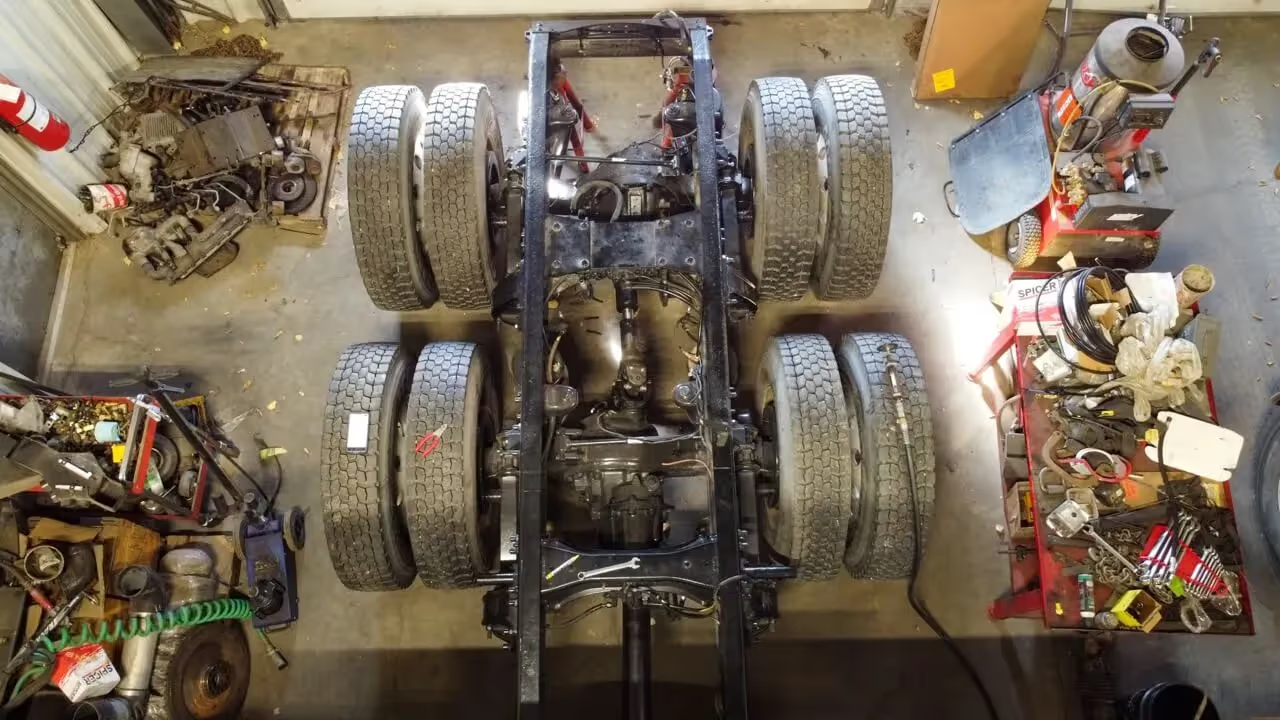
A heavy-duty driveline must reliably transfer engine torque to the drive axles at speed and under load. In practical terms, this means the driveline must stay aligned as the chassis flexes, the suspension moves, and operating conditions change. In this system, driveshafts connect the transmission to the differential and need to rotate smoothly to prevent damaging vibration and accelerated component wear.
On many longer wheelbase trucks, manufacturers use a two-piece driveshaft instead of a single long shaft. The key component enabling this setup is the center support bearing (commonly called a carrier bearing). It supports the shaft assembly, helps keep it aligned, and reduces vibration and “whip” tendencies associated with long rotating shafts.
A rotating shaft experiences not only torque but also bending forces and dynamic behaviors that can become unstable at certain speeds. Engineering references commonly define “critical speed” (also called whirling speed) as the speed at which transverse vibrations can grow significantly, especially as shaft length increases and stiffness decreases. Generally, longer shafts are more susceptible to whip and resonance, which is why vehicle applications often divide long spans into shorter sections with intermediate supports.
A two-piece driveshaft addresses this by adding an intermediate mounting point (the carrier bearing) that supports the driveline near the middle. By shortening unsupported length, the design helps control whip tendencies and enhances stability at operating speeds and under load.
A center support bearing assembly typically includes a rolling-element bearing supported by an isolating elastomer, usually rubber, and a bracket that attaches to the vehicle frame. Dana’s maintenance documentation describes the center bearing as a rolling-element bearing isolated with rubber, with a bracket designed for mounting to the vehicle frame.
From a functional perspective, the assembly helps support the driveline’s weight, maintain alignment, and reduce vibrations. Product literature for Spicer center bearing assemblies highlights NVH (noise, vibration, and harshness) isolation/dampening and keeping the proper driveline angle to extend component life.
Two-piece drivelines rarely fail due to a single cause. More often, a carrier bearing problem develops alongside other conditions that increase loads on the bearing, the rubber isolator, or the universal joints. The most common failure paths listed below are well supported by driveline engineering guidance and manufacturer service materials.
A rolling-element bearing deteriorates over time, especially if contamination enters, lubrication becomes inadequate, or operating loads surpass normal levels. Although a carrier bearing differs from a wheel-end bearing, the fundamental principle remains: bearing wear increases friction, heat, and noise, and can lead to severe mechanical failure.
Dana’s Spicer driveshaft service manual specifically warns that damaged center bearings or components can cause imbalance or vibration in the driveshaft assembly, which can lead to component wear and potential driveline separation from the vehicle.
The isolator’s purpose is to reduce driveline vibration and enable controlled compliance. When the elastomer cracks, softens, or separates, the shaft can move beyond its intended limits, leading to misalignment and increased bearing loads. Spicer product information emphasizes advanced elastomer design as a key factor in reducing vibration and improving durability, underscoring the importance of the isolator material for overall performance.
Universal joints do not transmit rotation at a constant velocity when operating angles are present, and driveline designs rely on proper geometry (“cancellation”) to manage those speed fluctuations. Manufacturer guidance often states that excessive operating angles decrease U-joint life and may cause vibration. Dana/Spicer engineering guidance references an actual operating-angle threshold (for bearing-life calculations), and the Spicer operating-angle calculator notes that operating angles above a few degrees can reduce U-joint life and potentially cause vibration.
Significantly, driveline angles can change when rear suspension geometry shifts due to wear, ride-height adjustments, or load changes. OEM technical materials also note that the rear suspension setup can significantly affect operating angles, leading to multiple issues when angles fall outside specifications.
“Phasing” refers to properly aligning yokes so that the joint motion is coordinated. Technical references indicate that proper phasing is crucial for stable operation without excessive vibration or premature joint failure.
This is especially important after driveline service: if a shaft or slip assembly is reassembled incorrectly, torsional vibration can suddenly occur. Industry technical notes clearly identify reassembly out of phase as a common cause of torsional vibration and detail the risks it poses to joints, splines, and centre bearing isolators.
Carrier bearings often fail alongside other driveline problems. Dana’s service manual warns that excessive looseness in slip member assemblies can cause imbalance or vibration, leading to component wear and potential driveline separation.
Carrier bearing problems usually manifest as vibration and/or noise that vary with vehicle speed and load. Common descriptions in automotive service literature include vibration felt under the vehicle during acceleration and noises such as grinding or spinning when the carrier bearing or U-joints are failing.
From a mechanical perspective, the symptom pattern makes sense: when the center bearing loses stiffness or develops internal looseness, the rotating shaft’s centerline can shift, increasing imbalance and causing driveline vibration. Dana’s service manual connects damaged center-bearing components to imbalance and vibration, and warns of wear progression and the risk of separation.
Since these symptoms overlap with tire, wheel-end, and differential issues, the most reliable method is to compare symptom timing (speed- and load-dependence) with a structured driveline inspection.
Carrier bearing issues should be treated as more than just a comfort concern. Dana’s driveshaft service manual includes clear warnings: damaged center bearings can cause imbalance or vibration, leading to component wear and driveline separation from the vehicle, which can result in property damage, serious injury, or death.
Even before catastrophic results occur, persistent vibration increases fatigue loading on U-joints, splines, and supporting hardware. Technical phasing guidance similarly states that high torsional vibration can harm universal joints, slip splines, transmission bearings, axle bearings, shafts, and gearing, and that excessive center-bearing loads can damage the rubber isolator in the center-bearing assembly.
The operating environment affects driveline wear indirectly by influencing road conditions, ride-height variation, and maintenance needs. Edmonton’s freeze–thaw cycles lead to pothole formation and deterioration of the road surface, which increases impact loads on vehicles and suspension systems. The City of Edmonton explicitly states that freeze–thaw cycles are a significant factor in pothole formation.
The City’s Snow and Ice Control Annual Report also notes that late October through mid-April is when snow, freezing rain, and freeze–thaw cycles are most likely, highlighting the seasonal risk of conditions that can damage road surfaces.
Road impacts are essential because suspension systems are designed to absorb them and manage rebound; without proper control, impacts can damage components not designed to absorb shocks.
In practical terms, rougher road conditions can accelerate looseness in mounts, fasteners, and elastomer components, and they can worsen driveline angle changes if suspension wear or ride-height variation is present. OEM driveline angle guidance explicitly emphasizes rear suspension setup as a key factor that significantly affects driveline operating angles.
A formal diagnostic process reduces unnecessary part replacements and enhances first-time repair quality. The goal is to verify whether the vibration or noise comes from the carrier bearing assembly, driveline angles, phasing, U-joints, or a combination of these factors.
A driveline vibration often correlates strongly with vehicle speed (driveshaft RPM) and load (torque transmission). A symptom that worsens under acceleration may indicate driveline imbalance, U-joint issues, or looseness in the support bearing.
Key items to check include:
Because driveline vibration can originate from U-joints or slip assemblies, inspection should verify:
When driveline angles go beyond recommended ranges, the risk of vibration and U-joint wear increases. Spicer notes that operating angles depend on driveshaft speed and that higher angles can reduce U-joint lifespan and increase vibration.
When OEM specifications are applicable, they should be adhered to, and OEM technical materials highlight the relationship between the rear suspension setup and variations in operating angle.
Phasing guidance outlines how to align yokes to prevent sustained vibration and early joint failure, and specialized technical notes describe torsional vibration that can occur when driveline components are out of phase.
A carrier bearing replacement may be needed, but the repair should address the root causes to prevent future issues. Spicer center-bearing materials underscore the importance of maintaining proper driveline angles and reducing NVH, indicating that correct installation and geometry are key to optimal performance, not just replacing the bearing.
Dana’s service manual framing is precise: vibration and imbalance can speed up wear and cause driveline separation, making “complete system verification” a safety-critical requirement rather than optional.
Preventive maintenance for heavy trucks involves a systematic process of inspecting, servicing, and maintaining components to prevent breakdowns and extend service life. It is clearly distinct from reactive maintenance and is especially important for heavy trucks operating in demanding conditions and subject to regulatory requirements.
In practical use, a preventive routine focused on the driveline should include:
Where Edmonton's road conditions lead to more frequent impacts and roughness, the need for regular inspections becomes even more critical. The City of Edmonton’s freeze–thaw explanation supports the expectation of pothole formation, and the handbook’s suspension section explains why controlling road impacts is necessary to prevent damage.
The following checklist helps identify issues early and initiates a planned inspection before vibration worsens. The recommendations are based on preventive maintenance principles and typical symptom patterns outlined in service documentation.
A two-piece driveshaft relies on the center support bearing to keep alignment, support the driveline, and reduce vibration. Engineering and manufacturer sources consistently indicate that long rotating shafts are prone to dynamic instability and vibration, making intermediate support a crucial design element for mitigating these issues.
When carrier bearing problems occur, common signs include vibration during acceleration and speed-related noise. These symptoms require immediate inspection because manufacturer service guides warn that damaged center bearings can cause imbalance/vibration, speed up wear, and potentially lead to driveline separation—an event with serious safety consequences.
Early detection is most effective when the diagnosis considers the entire driveline: carrier bearing condition, isolator integrity, U-joints, slip components, driveline angles, and phasing. This systems-based approach aligns with preventive maintenance principles and helps to reduce repeat failures.
If you operate in Edmonton, AB, and notice driveline vibration or carrier-bearing-related noise, book a structured driveline inspection with Adrenaline Diesel. A documented road-test pattern and a thorough driveline assessment (angles, phasing, support bearing, and U-joints) can reduce downtime and help prevent safety-critical failures.
Give us call or fill out our service request form to schedule your vehicle in for service at Adrenaline Diesel.

Adrenaline Diesel has extended service hours to ensure you get the best appointment time possible.

Sourcing parts for complex jobs is our specialty. We always aim for the fastest turnaround possible.

